The book does a wonderful job of making you feel at home in the chaos corners of your life, and then showing you the navigational power of meditation, kindness, and study. There are no false promises. Realizing emptiness is not going to make the electric bill disappear. However, as you understand the place money holds in your life, the bill becomes part of the path.
By Kellie Schorr
Everyone sing with me:
“I like big books and I cannot lie…”
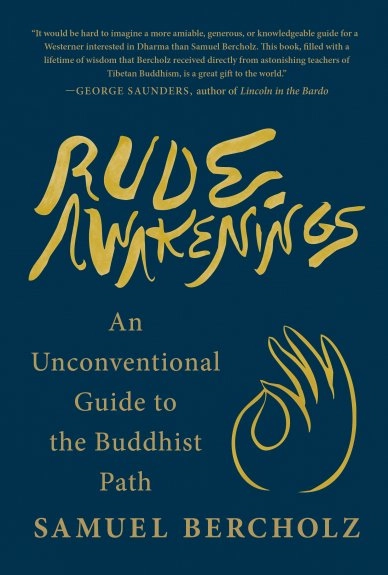
That was my first thought when I pulled this 370-page small-print, big teaching book out of the envelope. My second thought after seeing the title, Rude Awakenings:An Unconventional Guide to the Buddhist Path, was, “Did he mark every bathroom and gas station along the way?”
Yes. Yes, he did. This is one of the most complete and instructive Buddhist books I have ever read. Thankfully, it also has the distinction of being one of the easiest to read and most authentically presented books as well.
When it comes to explaining Buddhism, from beginner-mind meditation to esoteric Vajrayana visualizations, Bercholz sets out an absolute feast of ideas. I will warn you that this is not a “Buddha buffet” where you pick and choose what you want, but a luxurious 370-course meal served page to delectable page by a slightly grumpy, often humorous host.
Day by Day
Most of us are not monks or nuns. We aren’t living pure, ritualized existences where spiritual attainment is encouraged every moment and taking four hours a day to pray and chant is considered a reasonable way to live. We are ordinary people living messy everyday lives full of questions about work, money, sex, worry, hope, and fear. Our challenges can’t simply be renounced. They must be walked through, worked with, and understood.
Dharma isn’t something we can think about after those mountains, it is something we live while we are climbing them.
The book does a wonderful job of making you feel at home in the chaos corners of your life, and then showing you the navigational power of meditation, kindness, and study. There are no false promises. Realizing emptiness is not going to make the electric bill disappear. However, as you understand the place money holds in your life, the bill becomes part of the path.
There’s no flowery language or strings of Tibetan proverbs to contend with as you read through practices that are born for struggle and made to endure. The book is beautifully balanced. There are just enough personal anecdotes to let you know the author is there with you, and not so many that his “self” takes away from the teaching (a problem I find in a lot of Buddhist books).
No Escape
Buddhism isn’t some kind of sweet-smelling laundry detergent that is going to wash away your struggles and take you on a vacation to a lush island of bliss. For the myriad of practices, wisdom, and rituals contained in this volume, the message is pretty simple:
No one is coming to save you.
Once you accept that, it goes from being a call to clarity to a guide on how to reconnect with your own goodness as a way of walking, working, and living in this precious human life. Because this is a book of tools, not ideals, the concept is a lot warmer and more inviting than you might think.
Naturally, with Bercholz as the author, the majority of the book comes from the point of view of Shambhala teachings, however other teachings and paths, including Dzogchen, are offered. There is no assertion that the Shambhala path is the only or best path, and it does a good job of highlighting the universal bedrock of dharma from the Nyingma and Kagyu lineages. Its focus is steadfast liberation.
Grounded in Authenticity
My favorite thing about this book, even more than the anecdotes of his time with Chogyam Trungpa Rinpoche and Thinley Norbu Rinpoche, is the absolute authenticity found in the topic and the writing itself. Just as he advises us to work through our daily grind without avoidance, shame, or elation, he also works through messy topics in the same way.
Many teachers who were students of Chogyam Trungpa Rinpoche either avoid the topic of his behavior and choices altogether, like ex-wives ripping their partner’s face out of the picture, or strangely justify and over-explain the situation with a lofty, “He was a genius and his reasons remain beyond our ability to understand.”
Bercholz does neither. He talks about Chogyam Trungpa Rinpoche with affection but honesty.
Admitting he was a naïve 20-year-old as a student of the Shambhala International founder and the choices that were made in the 1970s were part of a culture we no longer accept now, he simply repeats what he knew and what he was taught. In explanations that are neither defensive nor salacious, when asked what Chogyam Trungpa was meaning to teach by having sex with students/others he simply says, “I don’t know. I didn’t have sex with him!”
He’s not afraid to speak on the “hot topics” of Western Buddhism. He openly states that Western Buddhism is too young, too new, to be guided without teachers from the origins of the tradition. He’s not impressed by self-empowered or newly minted lamas but also respects the views they add to the tradition.
Bercholz takes tough stands and makes it clear that Vajrayana contains “secret and forbidden” teachings, but the internet has pretty much let all the Tibetan cats out of the bag. Still, though it’s sometimes an unpopular thought, he maintains that to walk the Vajrayana path requires a teacher, empowerment, and a lineage.
Finally, from a stylistic point of view, I love his writing.
I am so tired of dharma teachers and self-called “dharma brats” writing books about Buddhist ideas while trying to appeal to younger, marketable audiences and “spice it up for the kids.” There’s no “so this enlightened dude named Siddhartha—we call him Big Sid—sees a Porsche with some wild students on their phones in it and…” and there’s no spiritually ethereal “may your lotus feet traverse the vast flowering of the day…” Reading it is exactly like sitting down to lunch with someone you know and respect and hearing what he has to say. It’s liberating.
I highly recommend this book for both beginners and people trying to deepen their experience on the path. It’s enjoyable, intelligent, and opens doors to thought you never imagined.
It’s a big book, worth every page.
Photo: Shambhala Publications
Did you like this post? You may also like:
The Wisdom of No Escape and The Path to Loving-Kindness by Pema Chödrön {Book Review}
Comments