It’s people who give me faith in the essential goodness of things and in the victory of truth. That what is happening now is not forever, that perhaps one day everyone, absolutely everyone who cares will go out on the streets and kick up such a monumental stink that some individuals might find it safer to hurry off to their tax havens.
By Tim Cooper
My first reaction to the call by Dana for articles on Hope was:
“Don’t bother. You gave up on hope a long time ago. Now you’re running on bloody-mindedness. You won’t say anything nice. It’ll be another extended bitching session about how life is so unfair to you and how nasty everyone is, and you’ll only end up attacking middle-class American Buddhists, because that’s easy and gets a cheap laugh.”
Envy is a cruel poison.
But even so, I went off and asked Claude the difference between faith and hope, because that’s one of my sticking points. Claude the Sycophant gave me a lot of information that didn’t really clarify anything, so I had to think for myself.
Two sentences:
1. I hope that things will change for the better.
2. I have faith that things will change for the better.
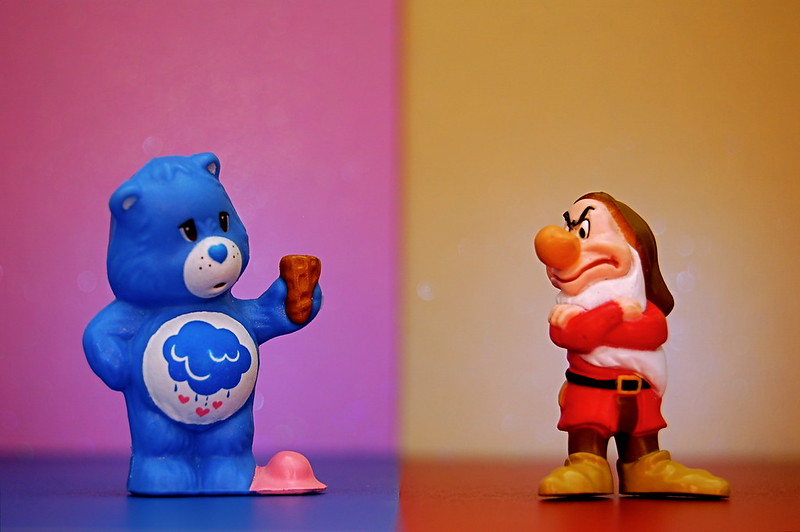
I don’t know about you, but sentence one sounds like something a Care Bear would say. I’ve argued about this with Claude the Sycophant, my partner and one or two others. To me, hope sounds transitory, fleeting.
Sentence two has a more solid ring to it. It summons up images of Gandhi and Martin Luther King. People whose faith in the inevitability of truth winning out over evil was sufficient for them to face every manner of injustice and stupidity and leave an indelible mark on the world, and change it, for the better.
Some people like to justify and support their half-baked arguments with etymology, and I’m no different.
Faith harks back to the Latin fides, which back then meant “confidence,” “trust,” “reliance.” It was only in the 14th c. that it began to denote, “assent of the mind to the truth of a statement for which there is incomplete evidence,” particularly in religious contexts. Since then, “faith” has been associated with a belief in old men with long beards who punish you with cankers and boils for having impure thoughts about the baker’s daughter.
But I’d argue that faith still retains something of its original meaning—a deeply held trust and confidence in something or someone, without there necessarily being any solid scientific proof. In my case, evidence does appear that instils me with faith. And by that, I do not mean faith in the cantankerous old gent with the beard.
My current feeling about so much of what’s going on in neoliberal fantasy land can be summed up in a short scene from Fawlty Towers, one of the best BBC comedy series every made. Basil, a nasty hotel owner and his equally nasty wife are having a conversation about happiness:
Sybil: You seem very jolly.
Basil: Jolly?
Sybil: Yes, jolly. Sort of happy.
Basil: Oh, “happy.” Yes, I remember that.
“Happy” has become a fond and distant memory of a time before the strangely-coloured President (he really does overdo it with the makeup, or is he abusing the carrot juice?) arrived to teach us all that the important things in life are to be right even when you are wrong, and never, ever let anyone or anything belittle you, ever. But then again, the writing on the wall was plain to see even back in 2007, or 2001, or even 1979, when the Iron Lady and the Cowboy told us that there was, “no such thing as society, there is only a collection of individuals.”
Does Buddhism help? Not me, not much.
The First Noble Truth is hard to swallow when so much suffering is caused by naked greed and indifference. I find it hard, if not impossible, to wave one hand limply at another cut in public health spending and mumble platitudes about karma. I still get offers from Buddhist publishing houses for books with titles like, Discover Your Inner Spiritual Tigress or Being Vegetarian in Times of Anxiety. Sadly, Small-Arms Training in the Theravada Tradition has yet to appear.
But there are truths that help one along the way:
Impermanence
Trying to be kind to others
Remembering that we’re all in the same boat.
Does Sanatana Dharma help? A bit more, perhaps. Gandhi regarded the Bhagavad Gita as his bible and used it as such to find solace in the interminable struggle to make India free. He was also a firm believer in the idea that truth always wins out; sooner or later truth is the victor.
At the same time, if I’m really honest, contemplative traditions and religion aren’t doing much for me right now.
It’s people who give me faith in the essential goodness of things and in the victory of truth. That what is happening now is not forever, that perhaps one day everyone, absolutely everyone who cares will go out on the streets and kick up such a monumental stink that some individuals might find it safer to hurry off to their tax havens.
If you think it’s impossible, look at Nepal, Bangladesh and Sri Lanka. After all, you can fool some of the people all of the time, you can fool all of the people some of the time, but…
A gesture, a phrase, something that breaks down that horrible feeling of being alone, penetrates the barriers and makes you see that a lot of us are not necessarily on the gravy train and have no intention of being there. And that gives me faith—not hope.
Because I am not a Care Bear.
The Tattooed Buddha is looking for articles on Hope for the month of November. Would you like to be a part of it? Send us your words to: editor@thetattooedbuddha.com. See submission guidelines here.
Tim Cooper is a more or less practicing Buddhist and recovering alcoholic who’s lived in Spain for over half his life. After many years of stumbling about in the lush gardens of Buddhism, picking one flower here and another flower there, he finally settled down and is trying to make sense of it all in the Tibetan Buddhist tradition, and generally trying to be a bit nicer. He works as a translator, teacher and facilitator with fellow ex-drunks. He likes flowers, rugby, bad science fiction films and cooking. He also likes to think he writes like Hemingway, but the rejection slips tell another story.
Photo: Flickr/JD Hancock
Editor: Dana Gornall
Did you connect with this post? You may also like:
Comments

- Mindfulness for Perfectionists: When the Cushion Becomes a Scoreboard - October 23, 2026
- Loving-Kindness for the Weeks That Are Too Much - October 6, 2026
- The Finger on the Glass - September 30, 2026