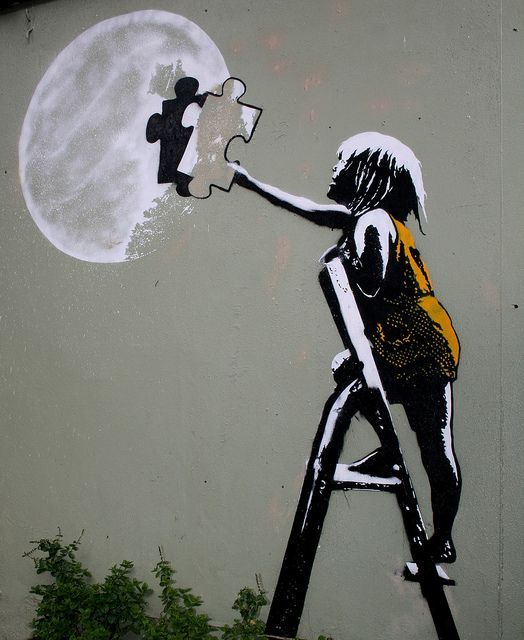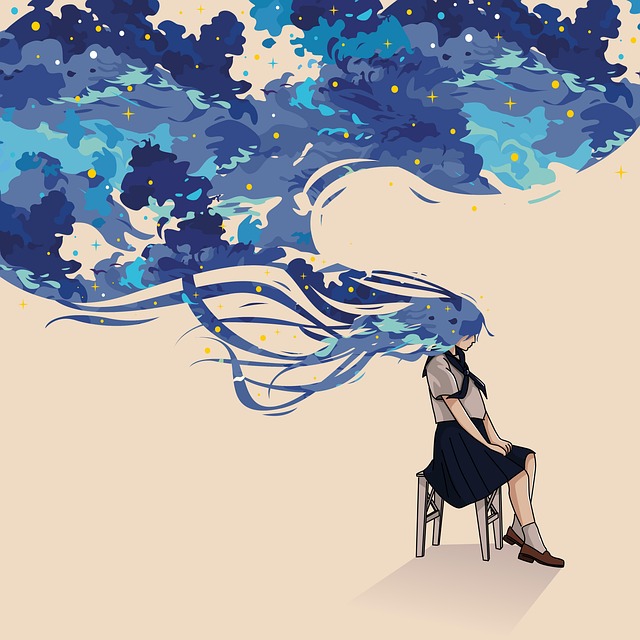
The dark self-signature loop works by fusing these layers together. Once fused, it becomes difficult to tell the difference between experience and verdict. A person may try to argue with the verdict. They may say, “No, I am not broken. I am worthy. I will be okay.” Sometimes that helps. Sometimes it does not. Sometimes the dark loop simply waits and replies, “You are lying to yourself.”
By K21
Sometimes pain does not appear as pain. It appears as truth.
A person does not simply think, “I am in pain.” The mind begins to write a verdict: “I am the pain. I have always been this. I will never become otherwise.” At that moment, pain has changed form. It is no longer only an emotion, a memory, or a bodily state. It has become a self-signature. It signs the person’s name onto a sentence written by despair.
This may be one of the most dangerous movements of the mind: suffering begins as an experience, but interpretation turns it into identity.
“I am hurting” becomes “I am broken.”
“This failed” becomes “I am a failure.”
“No one understood me today” becomes “No one can ever understand me.”
“I feel alone right now” becomes “I will always be alone.”
These sentences may sound clear, they may even sound logical, but clarity is not always truth. Sometimes clarity is despair wearing a clean mask. I call this movement the dark self-signature loop.
It is not the usual ego of pride, achievement, spiritual superiority, or self-importance. Many traditions and psychological systems are good at noticing the golden ego: the “I” that wants to become special, awakened, pure, impressive, or invulnerable.
But there is another form of ego that does not rise upward. It collapses downward.
It says:
“I am hopeless.”
“I am unworthy.”
“I am the problem.”
“I should disappear.”
“I finally see the truth: there is no way out.”
This is not humility. It is not insight, nor depth. It is the self turning pain into a final identity and the dark ego does not inflate the self. It imprisons the self. This is dangerous because it does not present itself as a mere thought, but rather arrives as a verdict. It says, “This is not a mood. This is reality. This is who you are.”
The problem is not only that the thought is negative. The problem is that the thought begins to feel like the ground itself.
A temporary state becomes a permanent definition. A wound becomes a name. A difficult hour becomes a life sentence.
In clinical language, parts of this territory overlap with rumination, hopelessness, repetitive negative thinking, and self-attacking interpretation. Rumination is not the same as careful reflection. It circles. It repeats. It returns again and again to the same wound. It appears to search for an answer while often deepening the groove.
Why am I like this? Why does this always happen? Does this prove I am broken? Will this ever change?
This is not simply “thinking too much.” When repeated long enough, it can carve a track in the mind. Pain moves along the track. Interpretation follows it. Eventually, a person may no longer feel, “I am having a thought.” They may feel, “This is reality itself.”
Depression is also not merely sadness. It can involve hopelessness, worthlessness, helplessness, difficulty concentrating, exhaustion, changes in sleep or appetite, and in severe states, thoughts of death or suicide. Self-harm and suicide risk are never caused by one single sentence or one single event.
They can involve mental health conditions, isolation, trauma, chronic pain, substance use, relationship loss, financial pressure, discrimination, impulsivity, access to lethal means, and many other layers. Still, within many dangerous states, a dark inner sentence may begin to form:
“This is not temporary.”
“This is me.”
“This is forever.”
That sentence is not only painful, it is possessive. It takes ownership of the person. The dark self-signature loop may move like this: First, there is pain, then, the mind tries to explain the pain.
Then, the explanation becomes personal.
Then, the personal explanation becomes identity.
Then, identity becomes destiny.
Then, destiny begins to look like a locked room.
At the beginning, the sentence may be simple: “I feel terrible today.” Later, it becomes:“I am terrible.” Then: “I have always been terrible.” Then: “I will always be terrible.” Then: “There is no point trying.”
Notice what has happened. The first sentence described a state, and the following sentences claim a nature. The last sentence begins to close the future. This is the moment where pain becomes metaphysics. The person is no longer only suffering. The person is being explained by suffering. The entire past is reorganized around it. The future is predicted from it. Other people’s words are filtered through it and neutral events begin to look like evidence.
A delayed reply becomes proof. A tired face becomes proof. A failed attempt becomes proof.
A memory from 10 years ago becomes proof. The loop starts collecting witnesses.
In ordinary life, this can look quiet. A person may be walking, eating, replying to messages, doing their job, or sitting on a bus. Outwardly, nothing dramatic may be happening, but inwardly, the mind may already be holding a trial.
The judge says, “This proves it.”
The prosecutor says, “You have always been like this.”
The witness says, “Remember that moment too?”
The sentence says, “Life imprisonment.”
And the person may believe the courtroom is reality, but a courtroom is not the sky. A verdict is not the ground. A sentence is not a person.
This does not mean pain is fake. Pain can be terribly real, loss can be real, depression can be real. Trauma and loneliness can be real. Social cruelty can be real. The body can be exhausted. The nervous system can be flooded. The situation may need help, protection, medication, rest, money, repair, law, distance, food, sleep, or another human being.
The point is not to deny pain. The point is to notice the extra act: pain begins to speak as if it owns the person.
“I am hurting” is one layer.
“I am the kind of person who can only hurt” is another layer.
“This is hard” is one layer.
“This proves my life is a closed room” is another layer.
The dark self-signature loop works by fusing these layers together. Once fused, it becomes difficult to tell the difference between experience and verdict. A person may try to argue with the verdict. They may say, “No, I am not broken. I am worthy. I will be okay.” Sometimes that helps. Sometimes it does not. Sometimes the dark loop simply waits and replies, “You are lying to yourself.”
The first counter-movement may need to be simpler than optimism. It may begin before hope. It may begin with seeing the sentence being written. Not believing the opposite, not forcing light. Not pretending gratitude.
Only seeing: a sentence is being written on top of pain. That seeing may sound small. But it matters. If the sentence can be seen as a sentence, then it is no longer identical with the whole sky. If the verdict can be seen as a verdict, then it is no longer the final nature of the person.
If the loop can be seen as a loop, then another movement may become possible.
The question is not, “Can I immediately feel better?” The first question is: What exactly is happening? Is this pain? Is this memory? Is this bodily exhaustion? Is this fear? Is this a practical problem that needs action? Or has pain begun to write a permanent identity?
There is a difference between saying, “I need help,” and saying, “I am beyond help.”
There is a difference between saying, “I do not know what to do tonight,” and saying, “Nothing can ever change.”
There is a difference between saying, “This relationship hurt me,” and saying, “I am unlovable.”
There is a difference between saying, “I made a mistake,” and saying, “I am the mistake.”
The dark loop erases these differences. It makes every state into a name and every event into a sentence about being. It makes the temporary sound eternal. This is why the loop must be handled carefully. If someone is in immediate danger, the task is not to philosophize about the loop. The task is to preserve life and bring in help. A doctor may enter. A friend may enter. A crisis worker may enter. A future hour may enter. Sleep may enter. Food may enter. A door may become visible again.
The dark loop says, “No door exists.” The first counter-movement does not have to say, “Everything will be beautiful.”
It can simply say: Wait. A sentence is being written.
Then:
Who wrote it?
Then:
Is this pain, or is pain pretending to be the whole truth? That pause is not a cure. But it may be a crack in the verdict. And sometimes, a crack is enough for help to enter.
Important note:
This essay is not a clinical tool or a substitute for professional support. If someone is experiencing suicidal thoughts, self-harm urges, a plan, access to means, or immediate danger, this is not a moment for solitary self-analysis. It requires real human support, emergency help, or professional care. In the United States, people can call or text 988 for the Suicide & Crisis Lifeline. If there is immediate danger, contact emergency services.
Photo: Pixabay
Editor: Dana Gornall
K21 writes about attention, self-observation, embodiment, and the subtle ways ordinary experience becomes self-description.

Did you enjoy this post? You may also like:
Right Thinking and the Punna Sutta: What to Do When We Come Across Hostility
Just Thinking: Relational Frame Theory and Psychology of Thought Tendencies
Comments

- Loving-Kindness for the Weeks That Are Too Much - October 6, 2026
- The Finger on the Glass - September 30, 2026
- Fishes’ Eyes Swim with Tears - September 12, 2026