It tells us to look for light and hope when we’re hopelessly lost in the darkness. It might not be obvious, like a single candle in a massive castle, but for folks who feel their way through the dark periods in their lives, the light and the hope you need are always nearby, waiting to be discovered.
By David Jones
Hanukkah, like all human holy days and traditional observances, has a rich backstory and plenty of historical meaning.
You can find plenty to read online. It’s a religious festival of a religious people, but it doesn’t have to remain a religious thing for those outside the Jewish faith. Like all Wisdom Traditions, there is teaching and goodness for all to be had within.
But to keep it alive and vital, we need to constantly reinterpret the event and its features for today; what does this story mean for you or me right now?
Here are some thoughts:
-It teaches trust and faith, reminding us that things will be okay even when we are absolutely not okay.
However you want to interpret faith and trust in your life, this story shows us examples in action. Even when you can’t imagine how things could ever get better, in some way and in its own time, they will.
-It tells us to look for light and hope when we’re hopelessly lost in the darkness.
It might not be obvious, like a single candle in a massive castle, but for folks who feel their way through the dark periods in their lives, the light and the hope you need are always nearby, waiting to be discovered.
-It teaches appreciation, something that doesn’t just apply when things are great.
Huddled around a single oil lamp in the darkness of life, maybe you don’t have what you want or what you’d prefer, maybe not even all you need, but really think about it: what do you have?
-Since Hanukkah is based on re-dedication, it’s about starting over with a fresh beginning.
Buddhism has rebirth and the Abrahamic religions have resurrection, we have Winter Solstice and birthdays and New Year’s Day—all parts of the human experience where we begin the grand cycles of life anew. It’s always good to consider how we can re-dedicate our lives in those moments of renewal.
-It’s about clearing away defilements and renewing efforts to become and remain pure.
Whatever temple you have in your life, literal or figurative, it’s a sacred place and deserves to be kept clean as a matter of respect at least. Our minds, our bodies, our altars and our spaces are sacred places which serve us best when we keep them clean and uncluttered.
-It’s about remembering community and our connection to each other.
In this age of separation and isolation, we need reminders more than ever about how we’re connected with each other. What connects us, and what do we do to maintain it?
-It’s about overcoming oppression in our lives and helping others overcome theirs.
What individual or group do you know who is suffering right now? How can you help them? Or could it be you who could use the support and help of connection?
-It reminds us of the value of remaining faithful to our promises, our vows, and our principles in life.
The story is a drama, wherein it seemed the people had been abandoned, forsaken, helpless and alone. But even in the worst of times there is wisdom in saying, “I may be alone but I am not alone.”
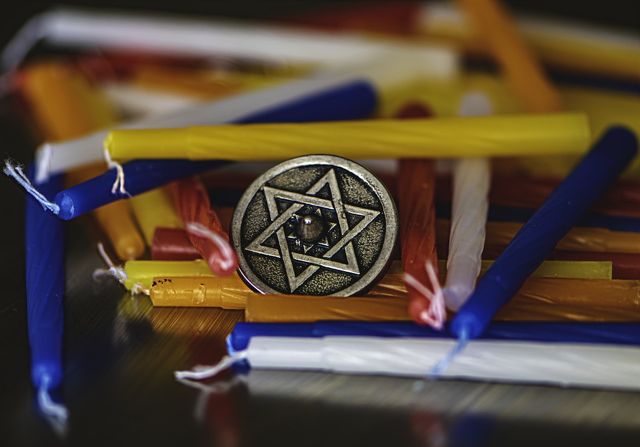
The “shamash” is the ninth candle which is actually used to light the other eight. “Shamash” is defined as the helper, servant, or assistant. Stories are our helper, our servant, our shamash. They help us connect with our past, our culture, our views and values. They help us make sense of the universe, the modern life, and our place in them.
I think the most important thing we can do in the dark periods of life is to remind ourselves that there is hope, there are comforters and companions, the darkness will not remain forever. Faith is believing in the impermanence of our bad times, believing that they will end.
We can all be lights for others, little by little. One single candle is lit each night, adding to the light of the whole. Our own light might not seem very bright on its own, but as we pass our tiny flame on to the one beside us, together we can illuminate everything around.
I encourage each one to consider the Miracle of Hanukkah in your own way, finding illumination and meaning within and spreading your light to others.
Mazel tov.
Did you love this piece? Tip the author! Help support writers: paypal/donate
Photo: Pixabay
Editor: Dana Gornall
Did you like this post? You may also like:
When Lao Tzu, the Buddha, and Jesus Speak as One
For those of us who feel these truths in our bones, and maybe even have them inked on our bodies, these teachings are alive. They’re not museum pieces. They’re practice. Path. Breath.

- A Change in Stance from Jehovah’s Witnesses, and a Dream of Compassion - October 9, 2026
- Bringing the Religion We Practiced Before Onto the Path - May 29, 2026
- The Gender Trap - April 2, 2026
Comments
- A Change in Stance from Jehovah’s Witnesses, and a Dream of Compassion - October 9, 2026
- Bringing the Religion We Practiced Before Onto the Path - May 29, 2026
- The Gender Trap - April 2, 2026