My great-grandmother’s photo is on the altar, because she was my favorite. A flowered headband was a gift from a sister of the heart for my birthday when I turned 48. There are milagros from Mexico tucked into various spaces, and three small singing bowls, two of which were gifts when I ordained. There are dried leaves of a bodhi tree, like the one Siddhartha Gautama sat under when he reached enlightenment.
By Michelleanne Bradley
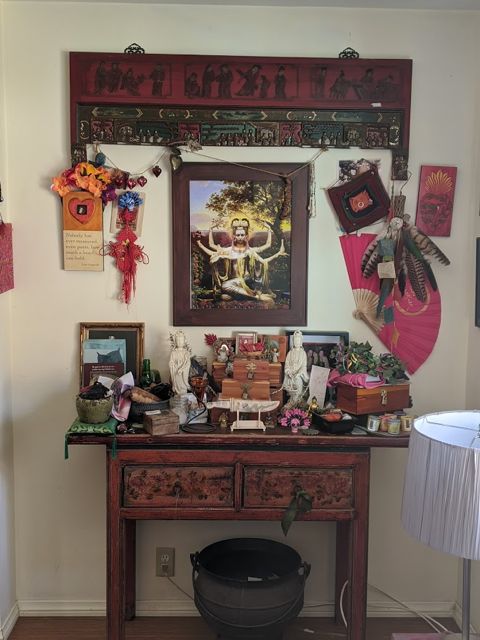
At the center is a framed depiction of Avalokitesvara.
There are also two porcelain statues of her on the altar, from the shop of a dear friend. The feather piece on the right is from Mexico, and is representative of the earth (stone), the air (the feathers), fire (it is used to move smoke during ritual), water (there is a shell in the handle) and we who partake in the ritual, our spirits are united by that which brings us together.
My great-grandmother’s photo is on the altar, because she was my favorite. A flowered headband was a gift from a sister of the heart for my birthday when I turned 48. There are milagros from Mexico tucked into various spaces, and three small singing bowls, two of which were gifts when I ordained. There are dried leaves of a bodhi tree, like the one Siddhartha Gautama sat under when he reached enlightenment.
A friend drew a picture and wrote a poem at the last retreat we went to, and gave it to me after it was on the altar built during the retreat. A nightlight that belonged to my mother when she was growing up is nestled in there too, and candles representing the chakras.
In the drawers are tarot decks, incense, sage bundles and sweetgrass.
There are framed photos of all of the pets I have had, and their ashes are currently still a part of the altar, although when I plant the next round of fruit trees in my yard, I plan to mix in the ashes with the soil, that they be a part of this place where I loved them and we shared our lives.
The cauldron is beneath the altar because it is a central part of my Pagan practice.
I have stones, crystals, and salt jars in there that are cleaned with energy of the altar. We used the cauldron this past weekend during ritual here at the house. I was telling a friend that the next day, I cleaned ashes out of it (we had burned paper on which we had written that which no longer served) and I burned an incense cone in it before returning the stones and crystals, and switched out the salt jars that are in each room of the house for purification and the smoke of the incense in the cauldron was beautiful and magical.
I know that to my minimalist friends this seems cringe worthy, but I see so much of the story of my journey in my altar. It is deeply personal, and includes pieces that I hold sacred to my faith.
Share your altar with us! Send a photo and description of your altar and why you have the pieces you placed on it!
Send to: editor@thetattooedbuddha.com
Did you like this post? You might also like:
Comments

- It’s Been One Helluva Week, but What Does that Have to do with Buddhist Practice? - September 16, 2026
- Trauma, Grieving and the Root of Suffering - January 25, 2024
- Releasing Resentment and Practicing Forgiveness - January 12, 2024