I’ve known a lot of people who’ve never started—or abandoned—-Buddhist practice altogether because they don’t have the time to sit, and they believe that sitting is important.
By John Lee Pendall
All beings are Buddhas. My thoughts, and the sense of mine-ness, both trail across awareness like feathers drifting a few inches above a trackless beach.
All minds are Jah. Footsteps, clips of strangers’ conversations, the beeps and burps of the self-checkout lanes, and the dry, withered rustling of products finding new temporary homes in plastic bags. My eyes sting for a moment as I step in from the night, the callous fluorescent lights forcing my pupils to suddenly contract.
Originally, there is no suffering.
My feet follow their familiar winding path to the time clock that some genius decided should be in the back of the store. It’s a gigantic store, one of the biggest of its dismal kind in this State. A tide of resentment and longing for sleep sweeps through consciousness; I don’t do anything with it, choosing to let it run its course instead. How I respond to unpleasant feelings depends on the situation. Often times, simply giving them room to breathe is enough; sometimes more active measures need to be taken. There’s no clear rulebook of when to use a particular technique, and if someone wrote one, I’d be immediately suspicious of it.
Buddha practice is experiential and intuitive—trial and error are your real teachers.
Babylon is Zion. Yes, I’ve been playfully dabbling with a kind of Rastafari-inspired Zen lately. One of the nice things about being John is that you can do whatever you want since you know that, no matter what, you’re just going to die someday anyway. I don’t recommend that those lacking in a natural moral compass try to follow in my footsteps, though—they’re the Buddha’s target audience, so they’d be better off rigidly following a particular tradition. In fact, you probably shouldn’t be following me at all; I’m prone to frequent excursions to the perimeter the same way we veered off-course into this sudden, largely unnecessary, commentary. That’s why I never force my personal path on those I am mentoring; I try to help them find their own paths.
Anyway, the pre-rambling part of this article was a snippet of day-to-day meditation. I’ve said it several times now, and I’ll probably keep saying it, that since we aren’t monastics, we can’t effectively practice methods designed for monastics. Even something like focusing on the breath, while it’s calming, is ultimately fruitless unless you can devote thousands of hours to it. Let’s be honest: if breath-work was all that and a bag of weed, there would be millions of capable Buddhas and gurus gallivanting across the globe. Judging by the ever-increasing decrepitude of our societies, this doesn’t seem likely.
It’s possible to focus on the breath in day-to-day life too, but it can be kind of a hindrance. Focused-attention meditations (FAM) can cause issues when we’re out and about. When I focus on something like the breath or a mantra while doing this and that, I tend to space out everything else—which is the point of FAM. Open monitoring meditations (OMM) are far more accommodating of lay life. Whereas FAM involves focusing on something in particular, OMM takes in the entirety of the living experience. With FAM, attention is supposed to remain fixed; with OMM, it’s allowed to be fluid.
All meditative methods fall into those two categories, and there’s a lot of crossover. Vipassana, for instance, can deal with resting openly with things “as is,” but at the same time, we’re on the lookout for certain sensations, feelings, mental factors or states of mind that can pop up. So, it’s rare for a method to exclusively fall into only one group.
That said, I think it’s skillful to choose a method that leans toward the OMM end of the spectrum. My formal sitting is as sporadic and undisciplined as everything else in my life. It takes a lot of hard work to be as undisciplined as I am. I used to feel a lot of guilt about not sitting for 30 minutes twice a day, but life is too short for me to feel guilty about something that stupid. So, I’ve worked with viewing life as zazen, and I only formally sit when my subconscious urges me to do so. I do go through several short bursts of inactivity throughout the day. I recently stopped smoking, so breaks and lunches at work are kinda weird. I intentionally have a cheap pre-paid cellphone to prevent myself from sapping my life into it, so I often just sit and do nothing while my friends scroll.
Like every other aspect of the Eightfold Path, each fold is connected to every other fold.
Right Concentration/Meditation depends on Right View, because without Right View, meditation can be selfish, shallow, and cause even more delusions to spring up than there were before. It depends on Right Thought because the desire to see things clearly strengthens our resolve to meditate. Right Effort is what helps to keep our practice from stagnating. Right Action, Speech, and Livelihood help to settle the mind which makes it easier to meditate. And, of course, Right Mindfulness is practically synonymous with meditation itself.
I do think that we can put on a kind of Buddha Patch, like the illustration jokes about. When I talk about meditation, I’m usually talking about a meditative lifestyle, rather than any kind of formal sitting. I’ve known a lot of people who’ve never started—or abandoned—-Buddhist practice altogether because they don’t have the time to sit, and they believe that sitting is important. They’re right, it’s extremely important, and being a monk is still probably the “best” way to practice Buddhism. But, like Genesis sang, “This is the world we live in (Oh-oh-oh).” Our choices are: renounce it, adapt to it, or mal-adapt to it. I’m all about adaptation.
The point is, I think, to make the Path into something alive.
This body, this mind, even this ego—they’re the pavement of the Path. One way to be a Buddhist in the modern West is to be the Path rather than follow it, so that in all aspects of one’s life, mindful attention is identical to meditation.
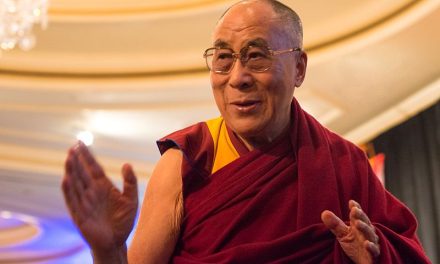
Picture: (source)
Editor: Dana Gornall
Did you like this post? You might also like:
Meditation: Tired of sitting? Consider walking.
Our environments and surroundings aren’t distractions to try and block out while we practice; in fact, they’re what we’re focusing on.

- Buddhist Struggle: Love, Happiness & Nihilism - June 2, 2026
- How the Walk for Peace Brought Me Back to Buddhism - February 11, 2026
- The Path of Emptiness - December 12, 2025
Comments
- Buddhist Struggle: Love, Happiness & Nihilism - June 2, 2026
- How the Walk for Peace Brought Me Back to Buddhism - February 11, 2026
- The Path of Emptiness - December 12, 2025