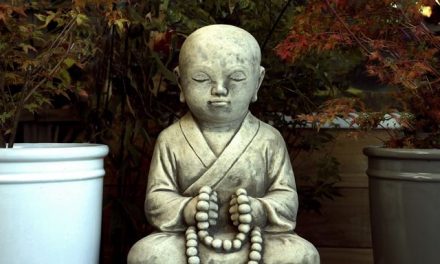
I’m a Natural Buddhist. Unlike Traditional Buddhists, I don’t believe in karma or rebirth, so these cycles of love and loathing—of peace and pain—all fade to nothing in the end, as if they never existed at all. The Path is just this life. This universal, selfless love doesn’t have the chance to grow across lifetimes.
By Johnathon Lee
I’m happier when I love the world.
I’ve lived many lives in this life. From the wide-eyed explorer to the wet-eyed bereaved, there’s a simple pattern running through it: life is better when my heart is open. Loving everyone and everything is the surest path to peace. Love brings me to the present, yet it keeps me accountable to the future. Each blade of grass is meaningful, connected to everything else.
As Thich Nhat Hanh said, “There’s sunshine in this piece of paper.” We’re all one and simply seeking peace. Why wouldn’t I be gentle? Why wouldn’t I marvel at the profound beauty of Interbeing?
Well, because it’s all shit.
Grass must wither. Each connection will be cut. Everyone dies. Joy leads to sorrow, and sorrow leaves us pursuing more happiness.
We’re seeking an impossible peace, a state of endless satisfaction that nature just can’t provide. Nature is machinery that’s moving through seemingly endless cycles. When we can’t find peace, we seek solace in endless progress. More tech, money, commodities and lasting liberties.
Nature can’t provide that either. Nature can only provide the rule: whatever begins must end. Birth necessitates death. Progress leads to regress. What goes up must come down.
That means that even my love, no matter how selfless and cosmic, has to end too.
So, it does. Those periods pass. My mind gets murky again. I forget about it and plunge headfirst back into the spectacle and the grind. Biases and preferences swarm back in, perhaps a bit softer than before, but still chugging. Then love returns, and I once again set the bullshit down… for awhile.
I’m a Natural Buddhist. Unlike Traditional Buddhists, I don’t believe in karma or rebirth, so these cycles of love and loathing—of peace and pain—all fade to nothing in the end, as if they never existed at all. The Path is just this life. This universal, selfless love doesn’t have the chance to grow across lifetimes.
This is it. Our one chance at living. At least in this universe.
So, what’s the point in trying? It doesn’t really matter if I’m happy or not. It only matters if I think that it does. I could stop believing in happiness altogether and just see life as good times and bad times, all of them passing even as they arrive. Why love universally and unconditionally if happiness doesn’t matter and love never brings the world lasting peace? It seems more logical to give into my habits and instincts: loving few, hating few, and apathetic about most. Egoism and hedonism seem like natural coping mechanisms. My body bears their marks. Yet, one day, those marks will rot or burn away.
The lifeworld I inhabit will vanish forever, and the effects of my actions will dissolve into the wider world.
What does any of this monkey business have to do with Polaris? It shines oblivious to both its own beauty and ours. Unfazed by the fact that even its light will go out.
These are the uncomfortable questions we face when we naturalize and secularize Buddhism, but I rarely see Secular Buddhists asking them. They just use rebirth, karma and nirvana as metaphors and move on as if this doesn’t completely alter Buddhism’s existential foundations. Fate and oblivion change everything. Why practice Buddhism at all when each path wanders to the same pit?
I don’t know, and as the old Chan saying goes, “Not knowing is most intimate.”
It’s times like these, when our minds are reeling with doubts, that we trust in the truth of the moment. We do that by fixing our minds on one thing. Holding it. Feeling the connection between us and it. Seeing that this connection is always now and only now. Each change is a new connection, a brand new now.
As we do this, we start to see how short a moment truly is. The present is like a pinhead, and there we are, poised upon it… still.
Then, when we fall off (because we always will), we see that all beliefs are fruits of mind wandering. “I’m happier when I love the world,” is a big belief. It came from several moments of me loving the world and feeling happy at the same time. My mind (metaphorically) wandered through time to link universal love and happiness together.
Even my naturalistic beliefs are like that. What is death? What is oblivion? I can’t know without wandering to my memories for the answers, and those answers are always limited by my own nature and nurture. Even this belief about my beliefs is like that. It’s madness all the way down. But when I’m on that pinhead, all these big beliefs stop making sense.
I might be happy, but without knowing how happy I am or why. The same goes for loving and peace. Fortunately, there’s no room for loathing and misery here. There’s nowhere for suffering to land, no ground for clinging and craving to stand on.
Yet with a callous twist of cosmic irony, even this passes. I always fall from the pinhead, but the more often I balance on it, the easier it is for it to pierce the screen of my favorite delusions. That said, my critical nature tells me that this practice is just as absurd as any other. Why balance on that still center if we just fall off back into samsara?
I don’t know. Maybe we don’t really have a choice.
It just happens naturally, like a seed sprouting when the weather’s right. I do know—when I slip from the pin—that love shines easy when the present is clear. Happiness and peace join it like faithful friends.
May your soil be fertile, and each drought a bit easier to bear.
Photo: Pixabay
Editor: Dana Gornall
Did you like this post? You may also like:
Buddha Nature and Mindfulness: When Emotion Pulls Us into the Abyss
Comments

- Buddhist Struggle: Love, Happiness & Nihilism - June 2, 2026
- How the Walk for Peace Brought Me Back to Buddhism - February 11, 2026
- The Path of Emptiness - December 12, 2025