If we look about us right now, wherever we are, up, down, side-to-side, we won’t see any gap in the tapestry hung before our eyes. What we see is taken as real, obvious and self-evident.
By Aindriú Peers
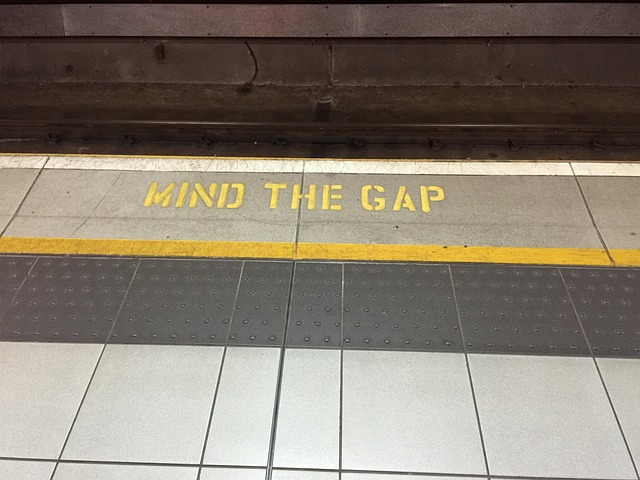
In London tube stations there are regular warnings over the tannoy saying “mind the gap.”
This is because the tube train compartments don’t always align well with the platform, creating gaps between platform and train. At some stations, there is quite a wide gap to hop over and accidents are possible.
Yet even if you do fall between platform and train, you still fall into more world, onto gravel or steel. You may break a leg but you won’t fall out of the world. There’s no real gap with regards to the world we experience. Our perception of it is always seamless and consistent—until death at least, and “we’ll worry about that one when we get to it.”
Stop a moment and have a look about.
If we look about us right now, wherever we are, up, down, side-to-side, we won’t see any gap in the tapestry hung before our eyes. What we see is taken as real, obvious and self-evident. Even the huge space we see from a jet plane or across a large field is somehow just the space and air bit. The world is completely convincing. We believe what the senses tell us because that’s common sense, and we pass this understanding on unquestioningly down generations because it’s an undeniable fact. There is no alternative approach anyway, we think. Nothing else to compare it with. You would have to be a dumbass to differ; you would have to be naive or in some kind of psychosis. Pre-coffee.
The world is so convincing because we cannot see a gap in it that might make us doubt.
Buddhism is a bitch because it says there is a gap. It says: look again.
It says that the pictures we see, play across a quiet background, and that the drama we are viewing is always projected. That simply this awareness is enough to eventually shift our perception in a small but crucial way. The following are words attributed to the Buddha on his enlightenment, according to the Dhammapada. Sometimes called his Song of Victory:
“O house-builder, you are seen! You will not build this house again. For your rafters are broken and your ridge-pole shattered. My mind has reached the Unconditioned; I have attained the destruction of craving.”
– Dhammapada XI, verse 154.
‘Unconditioned’ here might mean the dropping off of our ancient belief in the world, body and mind, the overlooking of our usual perception of it in order to “reach the Unconditioned.” Nothing else had changed for the Buddha except his perspective and his way of looking at things, the place he was looking from.
Belief after this shatters on the rock of knowledge.
Now we Know. This knowing is an Unknowing—a sublime Knowing. Working with koans in Zen Buddhism for example, or in Dzogchen practice in Tibetan Buddhism, the focus is on experiencing this gap—the first step towards living in the world while not being of it. It is the first move into transcending the madness, and a gap to step into.
Such knowledge doesn’t make us any more dumbass than usual.
We will still live life like everyone else. We’ll still “shit, shave and shower” in the morning. We work to put food on the table. Lock the bike. But now we no longer believe the game as if it were our final reality. We just act as if it was. This tiny gap—this tiny shift in perception—is experiential. It isn’t understood rationally and does not come from thinking. On the contrary, it takes us from inner vegetating to inner knowledge, to the visceral, and certainly that allows us to become fearless in the face of transience.
It allows unconditional cheerfulness to shine through, beyond our dense and oh-so convincing world. Stepping into the gap we see a happy dream once more and learn to play again.
We’ll write our own lyrics and sing out our own heartfelt cover of the Victory Song.
Photo: Pixabay
Editor: Dana Gornall
Did you like this post? You may also like:
Talking with Lee Carlson, Author of A Single Excellent Night: A Man, a Mentor & a Moment in Time
Comments

- Mind the Gap! - August 20, 2026
- Celtic Buddhism – the Extraordinary in the Ordinary - June 3, 2026
- The ‘Celtic’ in Celtic Buddhism - May 19, 2026