
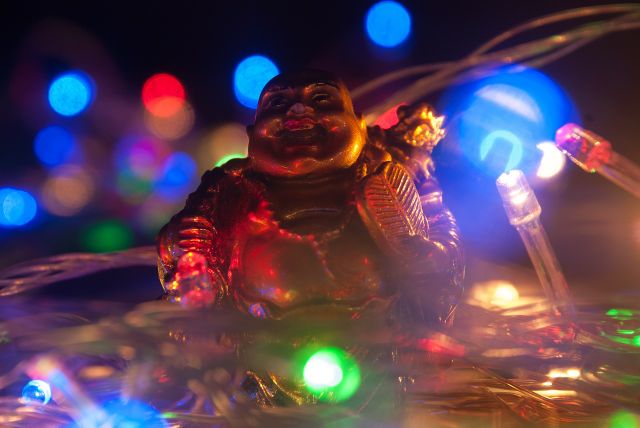
The best way to develop patience is to remember that every moment has a specific reality to it and is connected to all of us. We have to train our minds to say, “This is what this moment is” or use the newer Buddhist mantra “Right now it’s like this.” It’s more powerful than you realize.
By Kellie Schorr
Holidays in the Moment is a six-part series examining the paramitas, also known as the six perfections or the six transcendent actions, through the lens of the holiday season. These attributes help us to open up awakened heart and reduce suffering for ourselves and others. They are: generosity, discipline, patience, effort, wisdom and concentration.
Growing up, my family moved every two years.
They were big cross-country moves that kept us from creating a lot of holiday traditions. It was too tropical for hot chocolate in the Marshall Islands, and there was no point in getting a new bike in Langdon, North Dakota where the temperature was 20 below zero and the snow higher than my head. In El Paso, Texas the common response to White Christmas was, “keep dreaming.”
The only thing we managed to haul from place to place, nestled in a packing barrel marked XMAS under a mountain of newspaper and itchy fiberglass “angel hair” (you’d think their hair would be softer) was a box of ornaments my mother had collected over the years from our various stops.
Our tree was a chaotic mess of clashing colors, symbols, and meaning. Coconut shell ornaments from Kwajalein were placed beside a spaceman Mickey from Orlando, near a hanging bottle of white sand from New Mexico. Inevitably, every year something came out of the box broken, dented or lopsided. Mom would hand it to me after inspection and say, “Put this on the back of the tree.”
It would hang on a branch quietly, far away from the eyes of friends and guests who only saw the newest, brightest things. As an introverted child I always felt a little envy, and empathy, for the ornaments placed on the back of the tree to hang in oblivion. To this day, when I visit others I try to sneak and take a look to see what they put on the shy side of the limelight.
These days, with the hustle and bustle of a season that tends to leave us more hurried than holy, I’ve become aware of how potent the fear of that lonely place is in our lives. Not just at Christmas, but all year long. Those back branches make us feel damaged, or not “manifesting,” “achieving,” or worthy.
We are driven by “success culture” to exasperation, to snarl and snap, speed and strain, lean in and stand out so we can avoid being placed on the back of the life’s tree.
Without intention we become opinionated instead of wise, pushy rather than active, and anxious. So anxious. This is not who we want to be. It’s not how we want to act but it keeps happening. What can we do to stop it? Practice the paramita of patience.
Patience, like discipline, is one of those words we admire but don’t understand very well. Think of the things we say around the idea of patience.
“Patience is a virtue.”
“I’m patient but this person is on my last nerve.”
“I would be more patient if people would just cooperate.”
“Give me patience. Right now!”
We struggle with patience because we have the wrong idea. The old adage notwithstanding, patience is not a virtue (a quality or character trait we either have or don’t). Patience is a practice. It’s something readily available to any of us with intention and perspective.
Patience, like discipline, is one of those words we admire but don’t understand very well. ~ Kellie Schorr Share on X
Patience is letting each moment be exactly what it is. We get impatient when things are not what we want, when we want, at the speed that we want. When we are consumed with the desire or need to be on the front of the tree—to be seen, to be praised, to be considered valuable, or even just to help someone else—we try to change the moment into something that suits our goal. In doing so we act without patience bringing unhappiness or even harm into our path.
The best way to develop patience is to remember that every moment has a specific reality to it and is connected to all of us.
We have to train our minds to say, “This is what this moment is” or use the newer Buddhist mantra “Right now it’s like this.” It’s more powerful than you realize.
In line at the grocery store, I have a million things planned. I need to pay, get home, cook, finish some work and login for a class. I’m in “go” mode. Then it happens. The woman in front of me pulls out a binder filled with ads, tabs and notes. She says one of the most patience testing sentences ever: “I have some coupons.”
Minutes turn into millennia as she haggles with the cashier over store policies, amount sizes, and matching offers. I start looking at other lines, all packed. I breathe. I close my eyes for a moment. I fiddle with my mala. I smile politely. Internally, though—my blood is bubbling like a bath bomb. Why? Because this is not what I want this moment to be. It gets in my way. It pushes my needs to the back of the tree. And for what? 10 cents off a bottle of conditioner? ARGH!
If patience were a virtue, I’d either have it (“oh, I understand. Please do what you need.”) or I wouldn’t (“If I gave you a dime would you shut up and finish???”). Fortunately, it’s not.
Patience is a practice. It says, “Right now in this moment is a woman trying to stretch her budget, or show her family she cares, or feel powerful and smart because she’s got all this down. Right now she is with the cashier. I’m waiting. So, for me, this is a waiting moment. Waiting is what I’m supposed to be doing.” Once I realize that, the waiting becomes easier, and the smile is real again.
Some moments are front of the tree, facing the crowds under sparkling lights kind of moments. Others will find you hanging around the back in a dim corner hovering over a package of practical socks. Both are important. The more you can identify and accept the moment—waiting moments, listening moments, moving moments, active moments—the more patience you will practice and the more peace you will enjoy.
Joy isn’t where you are on the tree. Joy is in the moment.
Holidays in the Moment
Generosity is giving what you have to the moment.
Discipline is doing what the moment requires.
Patience is letting the moment be exactly what it is.
Photo: Source
Editor: Dana Gornall
Did you like this post? You might also like:
The Right Way to Let Go
The difference is that we don’t linger, and when we do, we don’t linger on the fact that we’re lingering. This approach is the opposite of dissociation; it’s full immersion. It’s being engaged with ordinary life.

Comments


