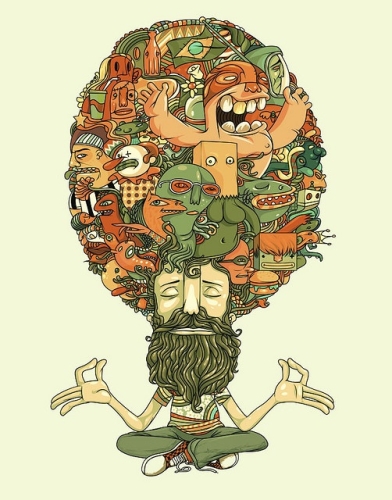
We humans seem to have a bad habit of wanting things to be a certain way, or have a certain outcome. We even have expectations of how the people in our lives should and should not behave, react, or become.
By Deb Avery
The Beatles had a hit song many years ago singing, “speaking words of wisdom, let it be.”
Then Buddhism became popular in the US and the phrase, “just let go” became a regular mantra for a lot of us. But what exactly is meant by let it be and let it go?
According to Buddhist philosophy (and the Beatles), it means to let go of our expectations of how things should be and to accept things as they are. Piece of cake, right?
Well, yes—and no.
We humans seem to have a bad habit of wanting things to be a certain way, or have a certain outcome. We even have expectations of how the people in our lives should and should not behave, react, or become. Regardless of how many times we’ve been shown that this is simply not possible, we still want to hold on to the possibility that we can somehow control another person’s actions, nor the events in our lives.
But the truth is, most of us are only able to see one dimension in a 3-D world.
For instance, if we knew that a pathway we are about to choose would bring pain, doubt and turmoil, would we really choose to walk that pathway? That might be what we would see with our one dimensional vision. But if we look deeper, on another level, we might see many more actions that would occur if we choose to walk this pathway.
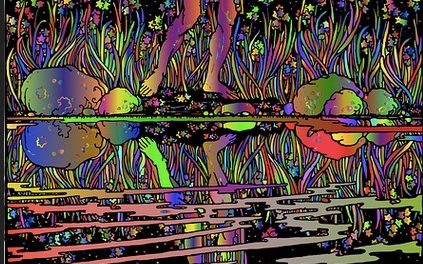
Much like ripples in a pond, our actions can have far reaching effects.
While some of these may be uncomfortable or even painful, that doesn’t always mean they’re bad. These effects, these ripples, are slowly and sometimes drastically changing us. We are becoming stronger, more courageous, and more willing to go outside the usual pathways that we have always traveled. In doing so, we may give courage, hope, or bring about positive results in our lives and the lives of those around us.
If we could see all the ripples, the effects that our decisions and choice of pathways would make in our lives, we would gradually understand that all pathways come together to form one big 3-D puzzle. Yet, here we are, stuck with one dimensional vision.
This is the reason we need to learn to trust our journeys.
We must choose our pathways based the best information we have at the time, our intentions, and the intuition that flows in our hearts and bodies from the wisdom passed along by our ancestors and/or our previous lives. And then, with this knowledge, we choose and accept our pathways, the journey, and the outcome.
This is acceptance and letting go.
But how do we raise it to an art form? That would be where grace comes in. And what exactly is grace? In its simplest definition, grace is defined as simple elegance or refinement of movement.
Imagine a ballerina’s grace as she dances so beautifully on stage. She makes it seem effortless.
But we all know that her grace and elegance is the result of many long, tiring, and often painful hours of practice over many years. Learning to be graceful while walking our path requires the same effort and practice.
We may start out walking with little grace and a lot of effort, stumbling and shuffling along the way. But as we become stronger and more adept, the more fluid our movements become and the less effort it takes to cover the trail before us. Soon, after much walking, we will become more graceful in our movements.
This is how we hone our instincts, improve our balance and our ability to stay on our toes—much like a ballerina. This motion of walking along our path with grace and elegance is the art of acceptance and letting go. Letting ourselves relax into the journey, letting ourselves be caught up in the cadence of life around us, following the twists and turns of the pathway, trusting our destination—this is letting go.
Accept the journey, let go and enjoy the walk, and just let it be.
Did you love this piece? Tip the author! Help support writers: paypal.me/debavery
Photo: (source)
Editor: Dana Gornall
Did you like this post? You might also like:
Nature, Noticing and the Lines We Leave Behind: A Conversation with John Muir Laws
Yet Laws is quick to note that wonder doesn’t require distance. “People say, ‘Let’s go to nature,’ then drive five hours. But nature is in the spider in the corner of your apartment. Wonder is all around, all the time. To make life most alive, we must apprehend the daily presentations life gives us. That is the fabric of life itself.”

- Mom, Zen and Me - March 15, 2021
- Finding The Zen in the Pagan Roots of Halloween - October 31, 2019
- When Words Fail Me - July 18, 2019
Comments
- Mom, Zen and Me - March 15, 2021
- Finding The Zen in the Pagan Roots of Halloween - October 31, 2019
- When Words Fail Me - July 18, 2019