At the workshop, the speaker felt as if he wasn’t reaching his audience. No one responded. Not a smile. Not a nod. No questions. He just kept plugging away however, working harder and harder to get a response and when it was all over, he took a deep sign of relief. Then, just as he was ready to turn and leave the podium something happened. The people in the audience began standing one by one. Ultimately, the entire group gave him a standing ovation. “That’s kinda’ what Advent is,” David said. “A period of time in which you just keep plugging along, doing what you need to do with hope.”
By Carmelene Melanie Siani
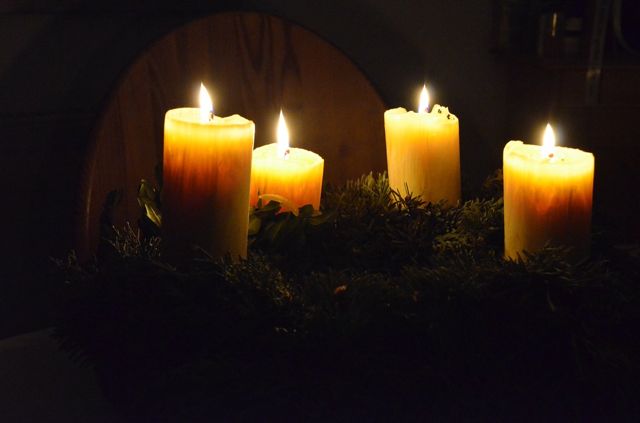
In an effort to make Christmas more personal and less commercial, my husband David and I committed to paying special attention to Advent, the Christian liturgical season leading up to Christmas.
Our goal was to answer some of the questions we had. What does Advent mean in the first place? Why should we bother? Can making an advent ritual part of our lives help us or inform us or even make Christmas more meaningful?
David had recently gone to a workshop in which the speaker told a story about how he had been giving a presentation to a group of peers. At the workshop, the speaker felt as if he wasn’t reaching his audience. No one responded. Not a smile. Not a nod. No questions. He just kept plugging away however, working harder and harder to get a response and when it was all over, he took a deep sign of relief.
Phew. He’d gotten through it.
Then, just as he was ready to turn and leave the podium something happened. The people in the audience began standing one by one. Ultimately, the entire group gave him a standing ovation.
“That’s kinda’ what Advent is,” David said. “A period of time in which you just keep plugging along, doing what you need to do with hope.”
“In the end you get the standing ovation called Christmas.”
He and I talked about how Christmas comes at a fixed time—once every year—but in real life Christmas doesn’t come only once a year. In fact, it may not come until every couple of years or every five years or even only once in a lifetime. That’s why we need to have Christmas every year… as a reminder of the promise of light and hope that follows Advent.
We’re human. We need reminders.
We talked about how Advent is a time of confidence, discipline and commitment. It requires focus, watching, preparation and building a foundation.
We talked about how you can’t live just waiting for Christmas, expecting it to come to you. You have to makes its prophecy come true. For example. What if the three wise men hadn’t followed that star? Would there have even been a Christmas?
Four years ago, David took on a cancer research project that he is still involved in because at the time he felt something inside of him—something that told him, “there’s something there…something worth pursuing…something worth going after.”
So, maybe sometimes there’s a “star” that lights up inside of us first before we see one in the sky? Maybe that star inside is really the light that we follow?
“The key is to pay attention to the star inside.”
Finally, we talked about how Advent maybe doesn’t lead to an ending called Christmas. “In fact,” we agreed, “There is no real end to Advent. If there is, the end is the beginning.”
Pay attention to the star inside. ~ Carmelene Melanie Siani Share on X
Photo: Pixabay
Editor: Dana Gornall
Did you like this post? You might also like:
The One Track Mind
I think of it as the one track mind because I find that every thing is resolved easily when I don’t stray far from it. In the spaciousness of this mind events unfold and go on their way. I laugh when I have to and cry when we have to. Everything is experienced completely without rejecting anything or running towards anything. Thoughts are a natural consequence, to be seen and let go.

- Just Because I’m A Writer Doesn’t Mean I Know Stuff - October 26, 2023
- I Don’t Miss My Stuff…In Fact, I Wish I Had it All Back! - February 22, 2022
- Holding the Door Open is a Spiritual Act - January 15, 2022
Comments
- Just Because I’m A Writer Doesn’t Mean I Know Stuff - October 26, 2023
- I Don’t Miss My Stuff…In Fact, I Wish I Had it All Back! - February 22, 2022
- Holding the Door Open is a Spiritual Act - January 15, 2022