Look how many of us wanting to make a meaningful contribution to society end up in generic corporate roles that neither improve the lives of others or bring about meaningful self satisfaction. If our present is not bringing benefit to others, then what do we have?
By Rob Argent
Growing up in the 90s, a lot of the music I listened to was deeply influenced by punk and its DIY attitude to social change and non conformity.
From its views on personal appearance and makeshift fashion to its wider political stance, the bands of the late 70s still influenced the grunge, nu metal and dance genres that were prevalent 20 years later. Even if the musical ideas were different—and in the case of rave and jungle they very much were—that underlying importance of self expressionism and communal support was still there.
Communities were created that allowed people to experience their lives in a more honest, authentic way, much as a Sangha has done over the past 2,500 years.
Protest has always gone hand in hand with the punk spirit, and like so many other movements fighting for social justice and long lasting change, there is always the ever present threat of burnout. After all, no one could stay angry forever and really, no one wants to.
The Buddha himself viewed anger as one of the three poisons alongside greed and illusions; two other very real threats that can pull us away from our good intentions into a state of suffering. For many involved in the activist world, that fire—that righteous indignation—is seen as a necessary fuel that keeps them going in the face of public indifference, potential setbacks, the lack of perceived immediate success, and a vast corporate infrastructure that is encouraged by leaders and public alike to continue prioritising profits over environmental and personal well-being.
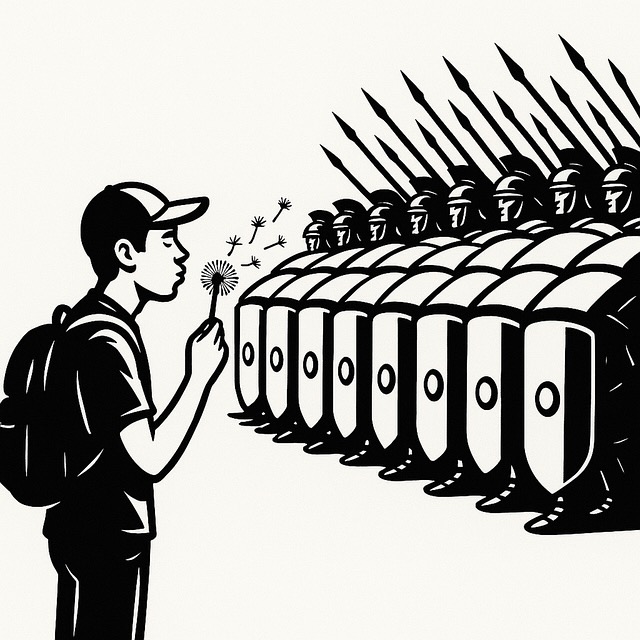
What happens to us when that fire starts to burn low, or worse, starts to turn inwards, leaving us disenchanted and feeling powerless?
I’ve seen far too many well-intentioned people dedicate themselves to a noble cause only for them to bounce off it only a short time later, believing that their contribution was too small, too inconsequential to make a real difference.
The problem here seems to be twofold.
The first is that we feel that our individual work has to be of noticeable significance in order to be worthwhile. This self-imposed expectation on ourselves is a prime example of our self nature that can lead to suffering. By understanding and accepting that the ego is simply a mental construct of our own design, we can learn to let go of this need to be validated by the recognition of others.
This selfless giving of ourselves to a belief or movement bigger than us can be freeing if we fully embrace it.
The second problem is that it is so easy to forget to take care of ourselves and learn when to step back and know when we need to rest. This ties in with the former issue of wanting to be an integral part of a community. Once the practise of anatta, or no self, is brought into play then we can let go of this attachment to praise and validation, both from ourselves and others.
Look how many of us wanting to make a meaningful contribution to society end up in generic corporate roles that neither improve the lives of others or bring about meaningful self satisfaction.
If our present is not bringing benefit to others, then what do we have? And isn’t this the exact same question that we ask ourselves if we’re toiling away in a meaningless job or trying to affect systemic change in our society? The world is changing but are we ok with the rate at which it’s changing?
Which leads me to sitting.
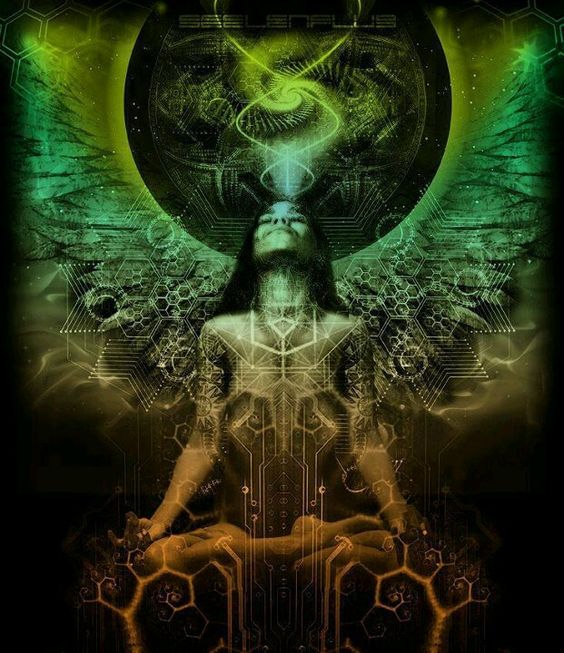
Whether it be on the meditation cushion or in general day-to-day life, sitting in and of itself a form of resistance. In that moment of being one with your breath, you’re not contributing to a capitalist society, or actively bringing harm to anyone or anything around you.
To simply be nowadays is a rebellion of sorts, removing yourself from a process of obey, consume, repeat (to quote an old John Carpenter film).
It’s not as dramatic as a protest march or as memorable as a protest song, but this act of just being in the moment gives us pause from the myriad of opinions and agendas being thrown at us from the media. Although we may practise to no longer attribute labels to ourselves, we often behave as workers and consumers on a subconscious level; just being still is now an active rebuttal to the world that we find ourselves in.
It’s not rock’n’roll, but seeing that Ramones and Nirvana T-shirts are now mass produced and sold on the High Street, even rock’n’roll isn’t rock’n’roll anymore. And if any idea can be co-opted and commercialised, stillness is perhaps the last bastion of the punk spirit.
Don’t say no, because you don’t have to say anything at all.
Rob Argent is an outreach practitioner, helping others recover from addiction, as well as being a qualified therapist. A lifelong interest in martial arts led him from Karate to Kung Fu, Tai Chi and meditation, and from there to Zen Buddhism in the Plum Village tradition of Thich Nhat Hanh. Bringing spirituality into daily working life is his interest, and in his spare time he enjoys rock music—the heavier the better.

Photo: Pixabay
Editor: Dana Gornall
Are you inspired by this? You may also like:
Sitting in Practice with American Zen and the Importance of Adaptation
Comments
- Sticking it to the Man, or Right Livelihood in the Modern Age - September 4, 2026
- Enlightened Playlists, or Why Listening to Albums is Good for You - August 7, 2026
- Why Punk Albums are (nearly) Always Short - July 3, 2026