Constant motion is stillness. Each doll—the fearful doll, the performing doll, the hidden doll—exists in the eternal now. Past, present, and future are constructs; the self is timeless. Aging, memory loss, and trauma leave marks, yet they do not define the ultimate self. Every layer exists simultaneously in the present moment, accessible to awareness regardless of chronology.
By George Cassidy Payne
When people talk about “returning to ourselves,” it sounds simple, almost wholesome, until you try to touch the self they mean.
Which self is it? The one shaped by habit and repetition? The one trauma carved its initials into? The one we perform to keep peace, to keep moving? Or the self we once buried just to survive?
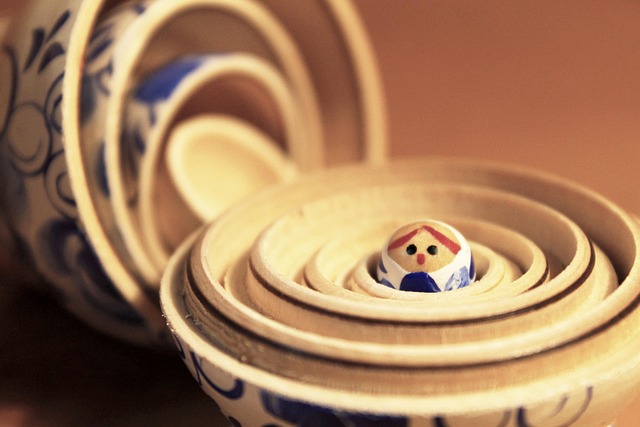
The self is not a single room waiting to be entered—it is a set of Russian dolls, layers within layers. Each doll is a self: the one shaped by fear, the one built to perform, the one hidden to endure. Some are bright, some chipped, some heavy with memory. And yet the real self can be seen in two ways: the innermost doll—the calm, witnessing presence that observes all the others, and the outermost doll—the self that moves through the world, acts, expresses and meets life fully.
Ancient Hindu philosophy speaks to this with startling clarity.
In the Upanishads, we read: “Atman is not this, not that.” The true self is neither a single story nor a single layer. It is the awareness that holds all layers within, and it is also the expression that interacts with the world. The innermost doll has always been there, quietly observing. It fully perceives all layers; nothing is inherently opaque. The outermost doll, shaped by all the inner layers, is where that presence becomes alive.
Returning to self is noticing both: feeling the steadiness inside and stepping into the self that faces the world with authenticity.
James Baldwin captured a similar truth: “We made the world we’re living in and we have to make it over.” Our inner world is no different. We inherit dolls we never asked for, but we possess the power to handle them gently, layer by layer, discovering the still, central presence they all enclose, and letting that awareness guide the outermost self as it acts and expresses.
Resilience and wellness coach Sylvie Maury, PhD, describes it beautifully: when our nervous system settles, we can finally sense what is real in the present moment instead of reacting from rehearsed habits and identities. From that steadier place, choice becomes freer, less tangled in fear or obligation. The self isn’t a role we perform; it is both the quiet, stable ground that remains when performance falls away and the outermost doll that engages life fully.
The yogic sages called that ground śānta atma—the peaceful self—not a personality but a presence. A clarity. A spaciousness. The thing in us that isn’t striving, defending, or performing, even as it allows the outermost self to act, move, and shine.
Mary Oliver caught a glimmer of this when she asked, “What is it you plan to do with your one wild and precious life?”
The “wild and precious” part isn’t about achievement. It’s about living from the self that is not trapped in inherited scripts, from the core that has always been there, and expressing it fully in the outermost layer that meets the world.
Returning to self doesn’t require movement in a single direction. It is recognition and participation: lifting the inner layers to see the quiet witness, and stepping fully into the outermost layer, grounded, steady, and alive. The outer dolls are rooms we pass through. The innermost is the stillness beneath the house; the outermost is the self-returning to life, fully present in the world. The more often we return, the more familiar both layers become, the core and the expression, steady, unhurried, unmistakably ours.
Always already here. Always already home.
If the self beyond the dolls is inseparable from connection, then each of us is not a solitary doll but a doll nested within larger dolls: the community, the planet, the universe. These relational layers are not external accessories; they are part of the self itself.
Our friendships, families and social networks shape how the innermost and outermost selves express and witness. Nature, ecosystems and the material world reflect the health and steadiness of the outermost doll. Cosmic forces, time, and existence itself form a vast, encompassing doll. The innermost witness recognizes that our individual dolls are nested in something immeasurably larger. The self that “simply is” is not isolated; it is relational, embedded, and interconnected.
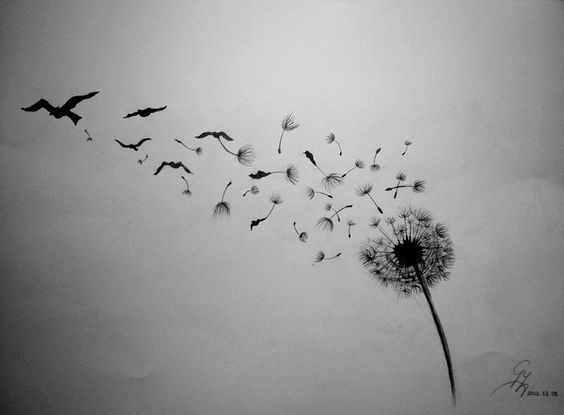
The dolls evolve as life unfolds, yet life is always unfolding. In that sense, perpetual change is itself a kind of stasis.
Constant motion is stillness. Each doll—the fearful doll, the performing doll, the hidden doll—exists in the eternal now. Past, present, and future are constructs; the self is timeless. Aging, memory loss, and trauma leave marks, yet they do not define the ultimate self. Every layer exists simultaneously in the present moment, accessible to awareness regardless of chronology.
Pure consciousness, awareness and freedom from suffering reside not in stopping change, but in embracing its immutability. The evolution of each doll is neither better nor worse than its prior state; it is simply the dance of life, observed from the still, inner witness.
The innermost doll experiences each layer fully while remaining untouched by temporal flux. Returning to self is acknowledging both the flow of dolls and the timeless ground beneath them. Growth and decay, joy and suffering, learning and forgetting are not contradictions but expressions of the same eternal now. The self beyond the dolls sees the perfection of change as unchanging, and in doing so, experiences freedom and presence that transcend linear time.
The body and self exist within each other; they are not separate.
Breath, movement, and sensation are forms of awareness. When we breathe, we breathe awareness. When we are aware, we are breathing. Moving is awareness. All sensation is a form of awareness. The innermost doll does not float apart from the body, it is the body in motion, the awareness in sensation, the quiet presence felt through every nerve, every inhalation, every step.
Returning to self is not only a mental act but a somatic one: to inhabit the body fully is to inhabit the self fully, to meet life with awareness in both mind and flesh.
Suffering arises from lack of awareness.
Desire is the root of all suffering. Attachment appears when one layer of the self no longer recognizes or is aware of the others. Returning to self is enlightenment. It is pure awareness. It can happen at any time and is happening at all times. Awareness of awareness is awareness itself, the ever-present witness that perceives all layers, holds all dolls, and remains steady amidst perpetual change.
Beyond the outermost doll lies nothing to acquire, nothing to perfect, nothing to add. It is the ground in which all dolls exist, the unchanging field of pure presence. This self is not experienced as an object, nor does it act. It simply is, the awareness in which every layer, every movement, every connection, every sensation arises and subsides.
It is the spaciousness before thought, the stillness beneath motion, the timelessness beneath time. The innermost and outermost dolls are expressions within this field, yet they do not define it. Returning to this self is not a journey or an achievement. It is recognition, realization, and participation in what has always been here: the luminous, unbound, ever-present ground of being, beyond all layers, beyond all dolls, beyond all form.
Photo: Pixabay
Editor: Dana Gornall
Did you like this post? You may also like:
Comments

George’s essays have appeared in publications such as The Good Men Project, The Buffalo News, The Rochester Democrat & Chronicle, and many more. A poet at heart, his work often blends memoir, philosophy, and theological reflection, rooted in the belief that language can be both a balm and a spark.
Whether reflecting on the writings of Marcus Aurelius, the parables of Jesus, or the mindfulness of a Jain monk sweeping the ground before them, George writes to make space for wonder, doubt, and dialogue.
He joins The Tattooed Buddha as a regular columnist to explore themes of death, inner peace, activism, grief, and contemplative life in a world on fire—and to ask, again and again: How can we live as if everything we do matters?
- Who Are You Beyond Your Labels? - August 19, 2026
- From Space Earth Looks Almost Unchanged, From Within Every Moment is an Opportunity - July 20, 2026
- Trauma and Remembering How to Heal - July 9, 2026