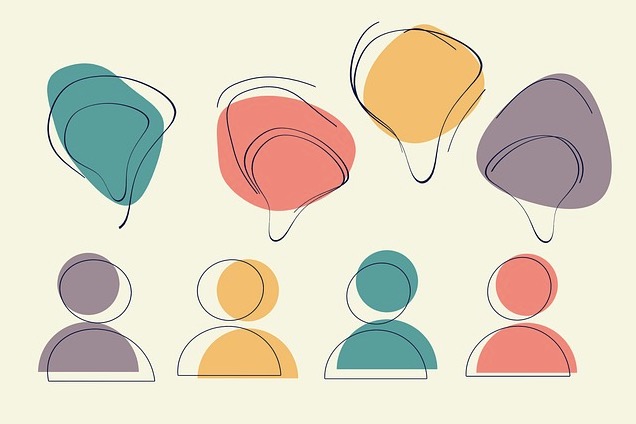
Imagine not being able to tell someone that you love them. You can act lovingly toward them, saying I love you in other ways, but the words have to stay stuck in your heart. Imagine never hearing anyone say that they love you. Not your parents, friends or partners. Not even your children.
By Johnathon Lee
Imagine if “love” wasn’t a word.
Let’s say we’re in an alternate world where most people decided that love was a bad thing. You can’t make love illegal, but you can erase its tracks. For the greater good, the censors set to work deleting the word from all media and even private messages. Using it could land you 20 years in prison.
There’s resistance, but they mostly succeed, and “love” is gone in three generations. So completely gone that it’s like it never existed to begin with. What would that world be like?
We usually think that experiences (inner and outer) come first and our symbols come second, and that’s definitely true. However, the opposite is also true. Words can alter perception.
There are cases of cultures not having a word for a specific color, and even though their eyes are fully functioning, they can’t see the color. Some flavors are like that too, with most Westerners unable to taste umami before learning about it.
Words also aren’t as arbitrary as we used to believe.
When shown two shapes, one sharp and one rounded, and asked to label each one kiki or bouba, almost everyone—across diverse cultures— agrees that kiki is sharp and bouba is round.
With all of this in mind, it’s possible that a world without “love” could become a world Love.
Imagine not being able to tell someone that you love them. You can act lovingly toward them, saying I love you in other ways, but the words have to stay stuck in your heart. Imagine never hearing anyone say that they love you. Not your parents, friends or partners. Not even your children.
You’re not alone in this since everyone would be doing the same thing, but you’d feel alone. Neglected and with a constant tension, an unexpressed warmth that starts to burn you alive.
Then the next generation grows up never hearing the word, yet they still feel love, but without a name for it,
They can’t quite grasp what it is. Without the label, there’s no way for them to slot it into their understanding of the world or themselves. They can use alternatives like, “I am close to you,” or, “I care about you,” but not love.
What happens to that feeling by the third generation? Is it there at all, a depth that’s always on their tip of their tongues? Or is it gone, replaced by cooler feelings like positive regard and instrumental companionship? Would they even know how to love themselves?
Because if you censor “love,” you’re censoring “lovers” and “beloveds” too. You’re removing an entire culture of history. Fast forward 100 generations. How would the academics interpret the remnants of love? Paintings and sculptures of people worshiping each other, melodies of transcendent longing and bliss?
Love extends beyond people as well.
You can see love in carefully crafted pieces, full of an exquisite attention to detail that might seem absurd to someone who doesn’t know what love is. Many historical tragedies, both real and fictional, would become incomprehensible. Why did Romeo and Juliet take their own lives? Only madness or ignorance could explain it.
Back to our world. It’s messy. It’s painful. Sometimes there doesn’t seem to be much of a point to any of it… but there’s still love. For better or worse. There are lovers and beloveds, and there’s the hope to be or remain among them.
All of this begs the question: what did our ancestors have words for that we don’t? What will our descendants have words for?
There are already ideas and feelings in us that we can’t express. Mixed, mysterious things that both agitate and attract us. There are new ways of doing things that we can scarcely imagine because there’s no means to fit them into current worldviews. If someone voiced it, they’d have to come up with a new word, and most of us would think that they were psychotic.
But there was a time when “individual” didn’t exist. “Freedom,” “enlightenment,” “beauty,” “God,” and “country” were inaccessible ideas, and we can see what the world was like without them in it. Then they gradually appeared, created by people voicing things that some others felt or believed but couldn’t share or fully understand.
Words matter.
It could be that mysticism’s view that the absolute truth is beyond words and letters comes from the fact that we haven’t been able to find the right word for it. Like the color borange or the tone delta-flat, it might exist everywhere, but so do our limits.
So, explore those unthought thoughts and unfelt feelings. Bring the seen together with the unseen, giving birth to new words and keeping others alive. Dare to be unintelligible and never stop loving.
Photo: Pixabay
Editor: Dana Gornall
Did you like this post? You may also like:
Comments

- Buddhist Struggle: Love, Happiness & Nihilism - June 2, 2026
- How the Walk for Peace Brought Me Back to Buddhism - February 11, 2026
- The Path of Emptiness - December 12, 2025