
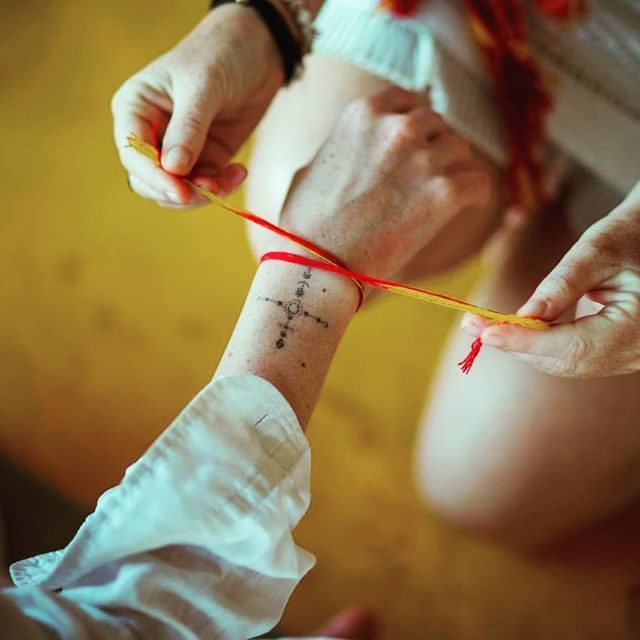

I still have a red string around my left wrist. I used to have a yellow string, a black string, and another red string. I guess I just let those fall apart. In olden times before synthetic fabrics, these strings would almost always fall apart after a few weeks, but now they can last for many years.
By Daniel Scharpenburg
Someone asked, “Why do these Buddhist strings have different colors? What do the different colors mean?”
Unfortunately I don’t have a satisfying answer for that question. Actually a lot of people seem to have questions about these little strings. I don’t know why, but I’ll try to address some.
I still have a red string around my left wrist. I used to have a yellow string, a black string, and another red string. I guess I just let those fall apart. In olden times before synthetic fabrics, these strings would almost always fall apart after a few weeks, but now they can last for many years.
These strings are part of the Tibetan Buddhist tradition. I don’t practice Tibetan Buddhism (sometimes called Vajrayana) but I did go to a Tibetan Buddhist Center for a long time, and that’s where I got the strings. I’m not sure why I still wear this one red string; I stopped going to the Rime Center over a year ago.
Sometimes these strings are called protection cords. They are viewed by some in the same way that Mormon magic underwear is, i.e. this can protect you if you’re in danger and bring you good luck. Sometimes people are really reluctant to admit that Tibetan Buddhism is really superstitious.
So, what are they?
Strings are often given when you take vows. I received my first Buddhist string when I took refuge vows at the Rime Center, which was red. I received another one when I took lay ordination vows and another when I took Bodhisattva vows. You can also receive a string when you receive an empowerment (I may write something about empowerments another time).
An empowerment is sometimes viewed as some sort of magical transference of energy, but often it’s viewed as an authorization to do a specific practice. Tibetan Buddhism has practices you’re not supposed to do without a teacher giving you permission.
The strings also can serve as reminders. I have a string on my wrist that I see all the time and maybe it reminds me to be mindful. It probably doesn’t though. I’ve been wearing it long enough that I’m totally used to it. So, if I’m honest, there’s not a chance this string is reminding me of anything. I suppose people in the know may see it and know they can approach me to talk about Buddhism… but my tattoos probably give that away anyway.
So, the different colors…Do they mean anything?
As far as I can tell, the answer to that is, no. The color of string is almost always red and when it’s not it’s just something the teacher has chosen. The teacher may try to relate it to what’s happening. They might use red for vows and different colors for different kinds of empowerments, but if you’re looking for a set rule, there isn’t one.
The color of the string is based on the teacher’s whim.
So I really wanted to answer that question about why Buddhist strings are different colors, but I’m sure the answer was really unsatisfying.
Photo: Imgrumweb
Editor: Dana Gornall
Did you like this post? You might also like:
Comments

He specializes in bringing meditation practice and Buddhism to people in a practical way that applies to real life.
Find out more about Daniel here and connect with him on Facebook
- Review of The Power of Mind: A Tibetan Monk’s Guide to Finding Freedom in Every Challenge {Book Review} - August 23, 2022
- The Path to Peace: A Buddhist Guide to Cultivating Loving Kindness by Ayya Khema {Book Review} - July 21, 2022
- That is Not Your Mind! Zen Reflections on the Surangama Sutra {Book Review} - July 16, 2022


