I wear robes, I chant, I bow and there is a Buddhist altar in my living room. This change occurred because hours in meditation showed me that Buddhism is as much a body-practice as it is an intellectual one. And like the adventurer who finds a hidden waterfall on a map, it’s not enough for us to know the path to our destination. We have to lace up our boots and walk there. My altar helps me walk.
By Sensei Alex Kakuyo
When I became a Buddhist I was against the use of altars.
In part, this was due to a youth spent in the evangelical Christian church, where we received daily warnings against false idols and eternal damnation. It was also due to the arrogance that’s typical of most westerners, which writes off devotional Buddhist practices as “cultural baggage.”
I believed in seated meditation and I enjoyed spending time on my cushion, but any outward show of faith whether it was an altar, a Buddha statue, or even wearing mala beads was too much for me to handle.
I wanted to keep Buddha and get rid of Buddhism.
However, years of practice have pushed me to the other end of the spectrum. I wear robes, I chant, I bow and there is a Buddhist altar in my living room. This change occurred because hours in meditation showed me that Buddhism is as much a body-practice as it is an intellectual one. And like the adventurer who finds a hidden waterfall on a map, it’s not enough for us to know the path to our destination. We have to lace up our boots and walk there.
My altar helps me walk.
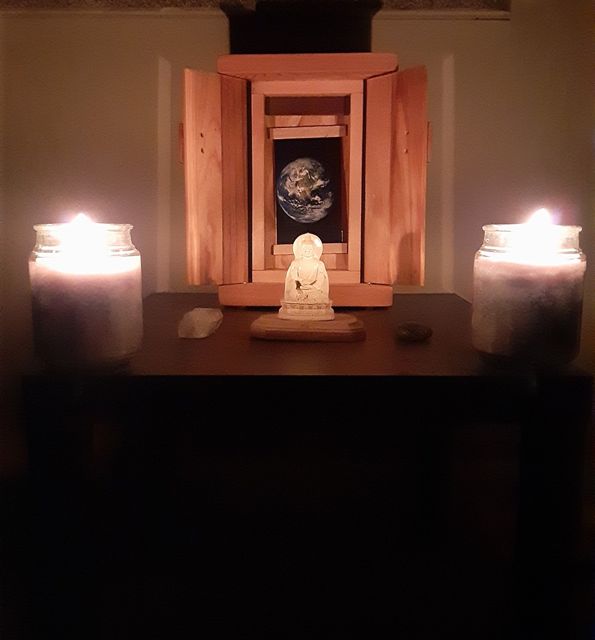
Most people would call it minimalistic, but each piece serves a purpose. At its center is a small Buddha statue that I bought the day I took the precepts. There is a Butsudan that was gifted to me the day I became a Buddhist teacher and candles that I use to make light offerings. Finally, there are two stones—one on either side of Buddha.
The one on his right is lemurian quartz and it represents Kannon, the bodhisattva of compassion. The one on his left is striated sandstone. It represents Monju, the bodhisattva of wisdom. I found the stones when I was in San Francisco doing an advanced meditation teacher-training.
So, one could say that my altar is an embodiment of my Buddhist life. Every piece represents a step I’ve taken along the path, and each piece also represents the people who’ve walked with me on that path. My altar reminds me of Buddha, who blazed the trail for others to follow. It reminds me of Kannon and Monju who act as guideposts when I’ve lost my way, and it also reminds me of the members of my sangha who rush to pick me up every time I fall.
It's not enough for us to know the path to our destination. We have to lace up our boots and walk there. ~ Sensei Alex Kakuyo Share on X
The practice of having an altar is the practice of remembering. We remember where we’ve come from. We remember where we’re going. And we remember those who’ve walked the path before us.
The practice of having an altar is the practice of oneness. It’s a practice that says there is no “me” without “we.” There is no “I” without “us.” Thus, it embodies Eihei Dogen’s teaching, which states, “To study the self is to forget the self. To forget the self is to become intimate with a myriad of things.”
The practice of having an altar is the practice of speaking with our ancestors. I hear their voices every night when I bow and give an offering—they say, “You are not alone.” They say, “Where you go, we go with you. Where you walk, we walk too.”
Their words comfort me, give me warmth when life is cold, and they remind me that when I sit before my altar, the entire world sits with me.
Namu Amida Butsu
Want to share your altar with us for the Sacred Little Altars Everywhere series?
Send us a photo of your altar and description to: editor@thetattooedbuddha.com
Did you like this post? You might also like:
Comments

You can follow him by visiting his blog, The Same Old Zen and on Twitter: @sameoldzen
- The Thing Within Us That Lives Off Conflict - February 6, 2025
- The Need for Intolerance - December 16, 2024
- Doing the Work and Planting the Seeds - December 9, 2024